What is actually going on
"Tech neck" is a nickname, not a diagnosis. It describes a posture rather than an injury: head drifting forward of the shoulders, chin poking, upper back rounding, held there for hours at a time because that is where the monitor is.
The load that creates is mechanical and unglamorous. Your head weighs ten to twelve pounds over the shoulders, and the further forward it sits, the harder the muscles at the back of the neck work to stop it dropping. They are not injured. They are simply on shift all day and never clock out.
The pattern is usually the same tissue every time: upper trapezius and levator scapulae holding the shoulders up, the suboccipitals at the base of the skull working to keep your eyes level, the pecs quietly shortening at the front, and the deep neck flexors doing very little because nothing is asking them to.
What a session does about it
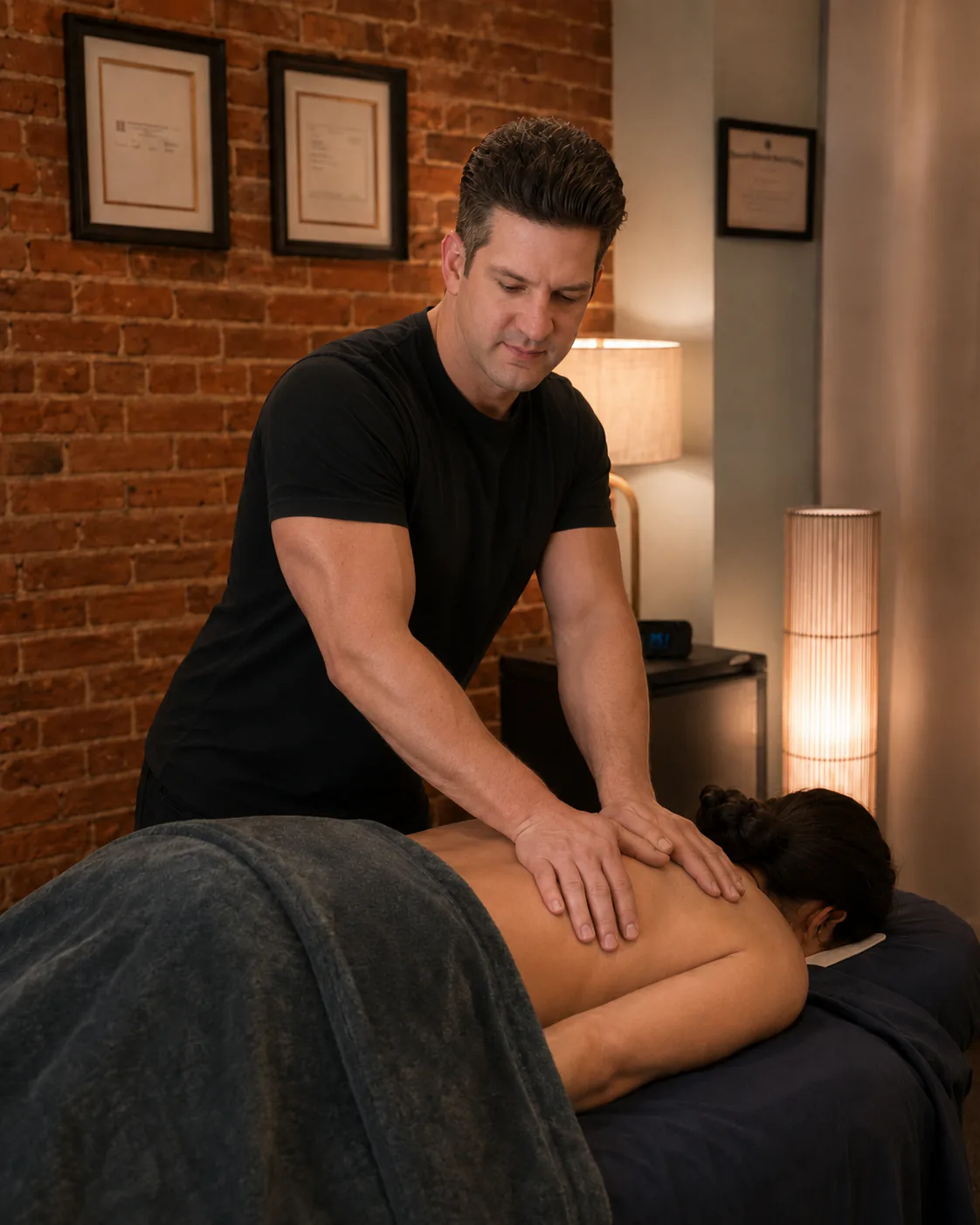
The work starts at the back of the neck and across the shoulders, because that is where you feel it — slow, specific pressure into the upper traps and levator, and careful attention at the occipital ridge, which is often the spot people are actually pointing at when they say their neck hurts.
It does not stop there. The front matters as much: chest and anterior shoulder tissue that has been shortening in a rounded position pulls you back into that shape as soon as you sit down again. Releasing the back without addressing the front is why relief from a generic neck rub tends to last about a day.
Sessions finish with movement — where your range actually stops, what changed, and one or two things worth doing at your desk. Not a printed exercise programme, just the two that matter for how you specifically sit.
What people describe
The most common things clients bring to this session:
- A tight, burning band across the tops of both shoulders by the afternoon
- Aching at the base of the skull, sometimes spreading up behind the ears
- Neck stiffness turning to check a blind spot while driving
- One shoulder consistently tighter than the other — usually the mouse side
- Tension between the shoulder blades that stretching does not reach
- Jaw and temple tightness that shows up alongside the neck tension
Massage therapy may support comfort, mobility, circulation and relaxation. Massage therapists do not diagnose medical conditions, and massage is not a substitute for medical evaluation or care. Neck pain with numbness, tingling, weakness in the arm or hand, dizziness, or pain following an accident needs a physician first — and if that is what is going on, TranquiLab will say so rather than work on it.
What actually helps between sessions
Massage manages the symptom. These change the input, and cost nothing:
- Raise the monitor so the top third of the screen is at eye level — laptop users need a stand and a separate keyboard, not better posture
- Get up every 30 to 45 minutes. Frequency beats duration; the tissue objects to being still, not to sitting
- Move the mouse closer. Reaching for it all day is why one side is always worse
- Take phone calls standing up, or on headphones — never wedged against a shoulder
- Open the front: doorway chest stretch, 30 seconds each side, twice a day
None of this is exciting, and all of it outperforms the massage if you only do one. Ideally you do both.
Getting here on a work day
TranquiLab is at 216 N Bernard St, inside SpaBlue in the City — in the middle of the downtown core rather than out on a commercial strip. Walkable from where most downtown desks are:
- The Riverside Avenue offices
- The Paulsen Center and Paulsen Building
- Spokane City Hall and the county campus
- The Spokane Convention Center — two to three minutes
- Riverfront Park — about five minutes
A sixty-minute session booked at noon has you back at your desk by one, with the walk at both ends. Weekday hours run 9am to 7pm, so before work and after work both work too. Metered street parking runs along Bernard Street and Spokane Falls Blvd if you would rather drive.
Sessions and pricing
Sixty minutes ($120) is enough for focused neck, shoulder and upper back work, and is the usual choice for a lunch break or straight after work. Ninety minutes ($160) makes sense when the pattern has been building for years, or when the mid-back and low back are part of the same story — which, for people who sit all day, they usually are.
HSA and FSA cards are accepted at the time of service. Insurance is not billed directly; a superbill is available on request if you intend to submit it yourself.
Book clinical & targeted relief massage
Online booking shows live availability. Sessions take place at 216 N Bernard St, Spokane, WA 99201, inside spablue in the city.
Common questions
Is tech neck a real medical condition?
Will one session fix it?
I get headaches from the tension. Can massage help?
Should I book clinical massage or a relaxation session?
Where to find us
Two to three minutes on foot from the Spokane Convention Center, the Davenport Grand and the DoubleTree by Hilton. Metered street parking along Bernard Street and Spokane Falls Blvd.