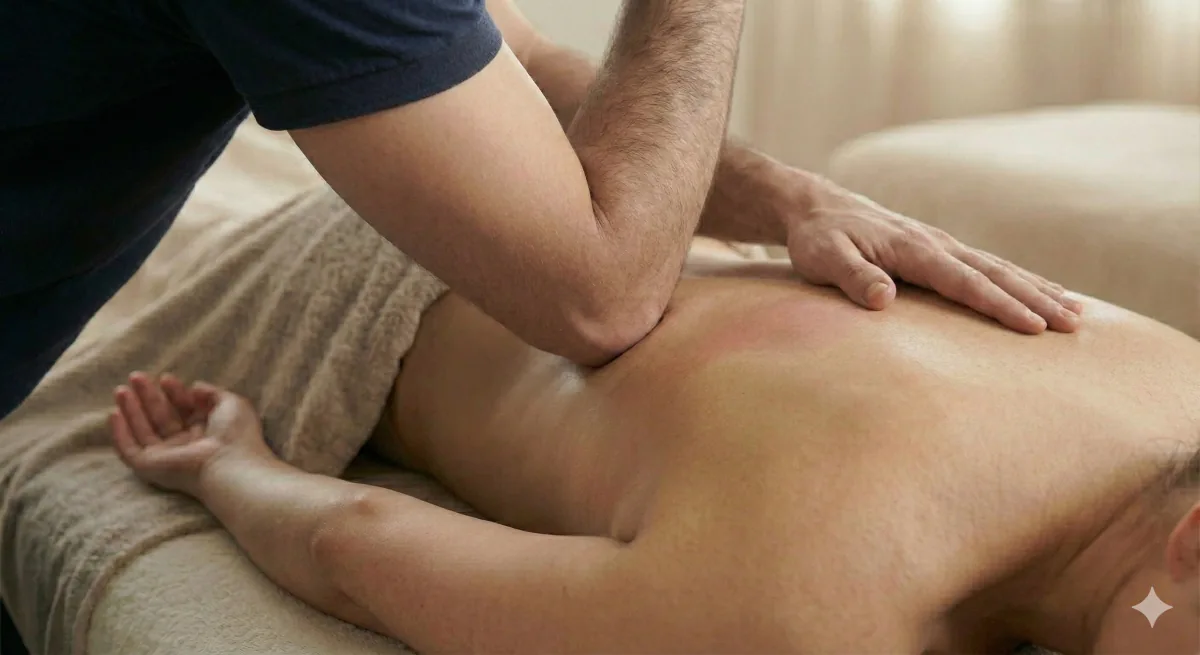
What clinical massage actually involves
A session opens with a short conversation and some functional assessment — watching how you stand, where a movement stops, which tissue is guarding and which is genuinely restricted. Two people with identical complaints of "low back pain" frequently need opposite work, and the only way to know is to look.
From there the work draws on whatever the tissue calls for: deep tissue technique for dense, chronically shortened muscle; myofascial release where the restriction lives in the connective tissue rather than the muscle belly; trigger point therapy for the specific tender points that refer pain somewhere else entirely; and targeted stretching to give the nervous system a reason to keep the new range.
Pressure is matched to how your tissue responds, not to a scale on a chart. Depth that makes you brace is counterproductive — a guarding muscle cannot release — so the useful range is firm and specific rather than punishing.
What people come in with
The most common reasons clients book clinical work at TranquiLab:
- Low back tension and hip tightness, often from sitting
- Neck, upper back and shoulder strain from desk and screen posture
- Hip and glute tension, low-back tightness, and discomfort that may extend into the leg — what many clients describe as sciatic-type discomfort
- Restricted shoulder or hip range of motion
- Recovery between training blocks, or after a period of heavier physical work
- Long-standing tension patterns that relaxation massage eases but does not resolve
Massage therapy may support comfort, mobility, circulation and relaxation. Massage therapists do not diagnose medical conditions, and massage is not a substitute for medical evaluation or care when needed. If something needs a physician, physical therapist or imaging, the honest answer is to say so — and TranquiLab will.
How many sessions it takes
For an active problem, three or four sessions spaced one to two weeks apart usually produce clearer change than the same number spread across six months. Tissue adapts to what is repeated, and a pattern built over years does not undo in one hour.
After that, most clients settle into maintenance every three to six weeks. You will get a realistic estimate at the first visit, and there is never pressure to buy a package to get it.
Sessions and pricing
Sixty minutes ($120) suits one or two focused regions — low back and hips, or neck and shoulders. Ninety minutes ($160) is the better choice for multi-area pain, full-body work, or anything long-standing, because the extra half hour is usually where the actual change happens.
HSA and FSA cards are accepted at the time of service. Insurance is not billed directly, but a superbill is available on request for you to submit yourself.
Book clinical & targeted relief massage
Online booking shows live availability. Sessions take place at 216 N Bernard St, Spokane, WA 99201, inside spablue in the city.
Common questions
What is the difference between clinical massage and deep tissue massage?
Does clinical massage have to hurt to work?
Do I need a doctor referral for clinical massage in Washington?
Where to find us
Two to three minutes on foot from the Spokane Convention Center, the Davenport Grand and the DoubleTree by Hilton. Metered street parking along Bernard Street and Spokane Falls Blvd.