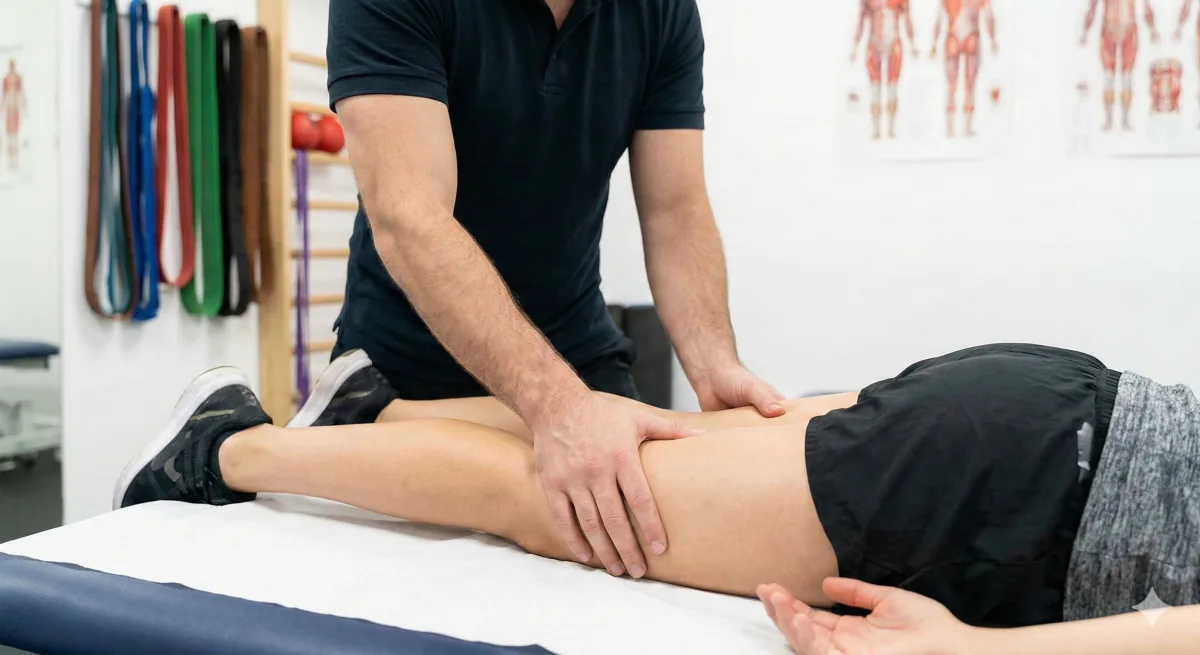
Timing it around training
Between sessions, in a normal training week, the goal is recovery: restoring tissue quality, addressing the areas taking disproportionate load, and keeping range of motion from quietly narrowing across a block.
In the days before an event, the work stays lighter and more mobility-focused. Deep, disruptive work close to a race or competition is a well-known way to arrive flat — the week before your goal event is not the time for the hardest session you have ever had.
Afterwards, sessions support the return to normal training rather than trying to force it.
Common patterns by sport
- Runners — calves, hamstrings, hip flexors, and the lateral hip structures that quietly limit stride
- Lifters — thoracic mobility, lats and shoulders, hip and ankle range that shows up in squat depth
- Cyclists — hip flexors, quads, and the neck and upper back that hold a riding position for hours
- Climbers — forearms, shoulders, and the upper back that never quite relaxes
- Winter sports — quads and hips after a season on Mount Spokane, Schweitzer or 49 Degrees North
For weekend athletes too
You do not need to be competitive for this to apply. If you are training for a first half marathon, playing in a rec league, or simply putting your body under load it is not used to, the same principles hold and the same session applies.
Book clinical & targeted relief massage
Online booking shows live availability. Sessions take place at 216 N Bernard St, Spokane, WA 99201, inside spablue in the city.
Common questions
When should I book a sports massage before a race?
Can sports massage help with recovery between training sessions?
Should I book 60 or 90 minutes for sports massage?
Where to find us
Two to three minutes on foot from the Spokane Convention Center, the Davenport Grand and the DoubleTree by Hilton. Metered street parking along Bernard Street and Spokane Falls Blvd.